Kategorie: Allgemein

High-Resistance Resistors for F3B Winches – Development, Function, and Benefits

I’d like to shed light on why these resistors were developed, how they work, and what benefits they bring. This report outlines the challenges that led to the idea, the development process, the results of extensive testing, and why I believe these resistors are a practical and affordable option for many pilots.


How It Started

The work began in 2020–2021, when competitions were suspended due to COVID-19. I had just finished my studies and finally had the freedom to attend more competitions, use my time more flexible to go for training and experiment with the hardware. I focused on finding the best setup for my winches.

In 2021, the limitation on cold crank current for batteries was lifted. This change made sealed AGM batteries possible: they are safer for transport, storage, and use in competition. With my small car and difficult transportation, I was eager to make a quick switch and welcomed the change. Additionally, I wanted to explore whether larger batteries would provide an advantage under high-current launches, so I purchased a large 105Ah Varta AGM battery. (Later, i would regret this heavy battery and I am not using it any more due to the impacts of its weight)

In early tests with an electronic load, the battery performed extremely well. But when I connected it to my winches, problems appeared:

  • Resistance too low: My stainless-steel resistor setup was no longer sufficient.
  • Bulky construction: To reach higher resistance, I had to chain two or three long resistors together.
  • Safety risk: Large exposed resistors made accidental short circuits more likely.
  • Heat: Minutes after simulated launches, resistors exceeded 200 °C. Heat transferred through the screws and clamps, causing painful burns even minutes later. (Guess, how i know 😉)

Clearly, stainless steel was not an ideal solution.


Sidenote (unrelated to these resistors):

Additionally, the better battery is no longer almost compensating the change in resistance of the motor if temperature changes. This lead to increased safety margins that i use myself. At the WC2023 we had a close measurement, even though we adjusted to min 23.7mOhm. Since i was not able to measure and adjust the winches as often at this years WC, we set up over 24mOhms at worst-case cold conditions just to be safe. The official measurements with over 25mOhms reflect that decision. It also helps with variating resistance of the motor, depending on the rotation position. But that is going into some other rabit hole…

Searching for a Better Material

I needed a resistor that was:

  • Smaller and easier to handle
  • Stable under high current
  • Affordable and easy to build

Kanthal was unavailable, and even if it were, it wouldn’t have solved the core issues. Stainless steel also had another disadvantage: its resistance increased with temperature.

My research in Wikipedia quickly pointed me toward carbon:

  • High electrical resistance
  • Low thermal conductivity (less heat transferred to clamps)
  • Inexpensive and easy to source
  • Negative temperature coefficient as a benefit

At first, I doubted carbon could carry the required currents. But our winch motors already rely on carbon brushes, so I decided to test it.


Prototyping and Early Tests

The first prototype was built within weeks, using simple tools: a block of copper, carbon rods, GFRP rods for stability and just a handsaw and drill.

Initial results:

  • Heat transfer to clamps was drastically reduced.
  • The size of the assembly could be made much smaller.
  • Abuse tests were promising: even after soaking the rods in water for days and then running currents up to 1000 A through one rod, the system continued to work without failure.

The main drawbacks appeared later:

  • Carbon is brittle. Dropping a hammer or stepping on the resistor would break it. This doesn’t happen under normal use, but accidents do happen…
  • Since i just joined team Foo occasionally, i was able to compare their winches better with my setup. Unfortunately, performance wasn’t even close with their setup. The hoped for benefit due to the negative temperature gradient can’t be so big.

Refining the Design

Through several iterations, I arrived at a much simpler and more robust concept:

  • Small carbon plates pressed directly onto conductors
  • Compact enough to be fixed on the winch itself (safer than on the battery)
  • Easy to protect with covers or under the winch
  • Simple to build with basic tools (saw, drill, thread cutter, no CNC)

This design is:

  • Safe – no exposed hot parts near the battery
  • Robust – less prone to damage from accidents and regular use
  • Less heat – much less heat in clamps and cables
  • Accessible – buildable in under two hours without special equipment

Measurements and Performance

To quantify the negative temperature coefficient effect precisely for this report, I compared stainless steel and carbon resistors in September 2025 using an electronic load with my large Varta AGM battery.

One 1second, 450A impulse simulates the measuring of the winch system.  (The winch is blocked and 300ms after the current starts, the current measurement is performed) The current is a bit too low
The simulated launch uses a current profile measured by MCM München in one of their older Magazines. I think it was 2007, when they did these winch measurements. I used the one with high current going over 440A, representing an extreme scenario that for sure represents too much current.

Stainless Steel Resistor

  • Length: 114 mm (≈ 1.2 mΩ)
  • Under 450 A impulse: nearly constant resistance (1.28 → 1.28 mΩ)
  • Under simulated launch: resistance rose slightly (1.28 → 1.34 mΩ)

Carbon Resistor

  • Dimensions: 5 × 8 × 14 mm block (≈ 2.8 mΩ)
  • Under 450 A impulse: resistance dropped (2.84 → 2.62 mΩ in 300 ms)
  • Under simulated launch: resistance dropped (2.77 → 2.01 mΩ, ~0.76 mΩ reduction)
  • But you have to reduce this by at least the reduced resistance at impulse load -> max 0.54mOhm reduction without including increasing resistance of cables, motor,…

Key Takeaway:
Carbon resistors do show a measurable drop in resistance under load, but the effect is modest. During the first half of a launch, this is even slightly negative: Effectively increasing your resistance.
Setting the correct resistance precisely is also trickier, since small adjustments in length produce large changes. This means that you must stay a little bit further away from the limit to be safe.


Lessons Learned

After hundreds of launches, oscilloscope measurements in the field, and years of refinement, I can conclude:

  • Carbon resistors are safe, robust, reliable, and cheap to build.
  • They solve the heat and safety issues of stainless steel.
  • They make AGM batteries easier to use. Therefore providing extra safety against overpowering batteries and during transport
  • The performance effect is small compared to the bigger factors: battery quality, motor selection, and—most importantly—training.

For me, the real value of these resistors was not about gaining a competitive edge, but about the process: experimenting, solving problems, and learning a great deal about how winch systems behave.

In practice, their advantage is clear—they reduce heat, are inexpensive to build, and make the winch setup easier and safer to use. The real performance gains still come from training and choosing the right motor and battery, but carbon resistors make the whole system more accessible and reliable for everyone.

Rangliste für 2027 und DM 2025

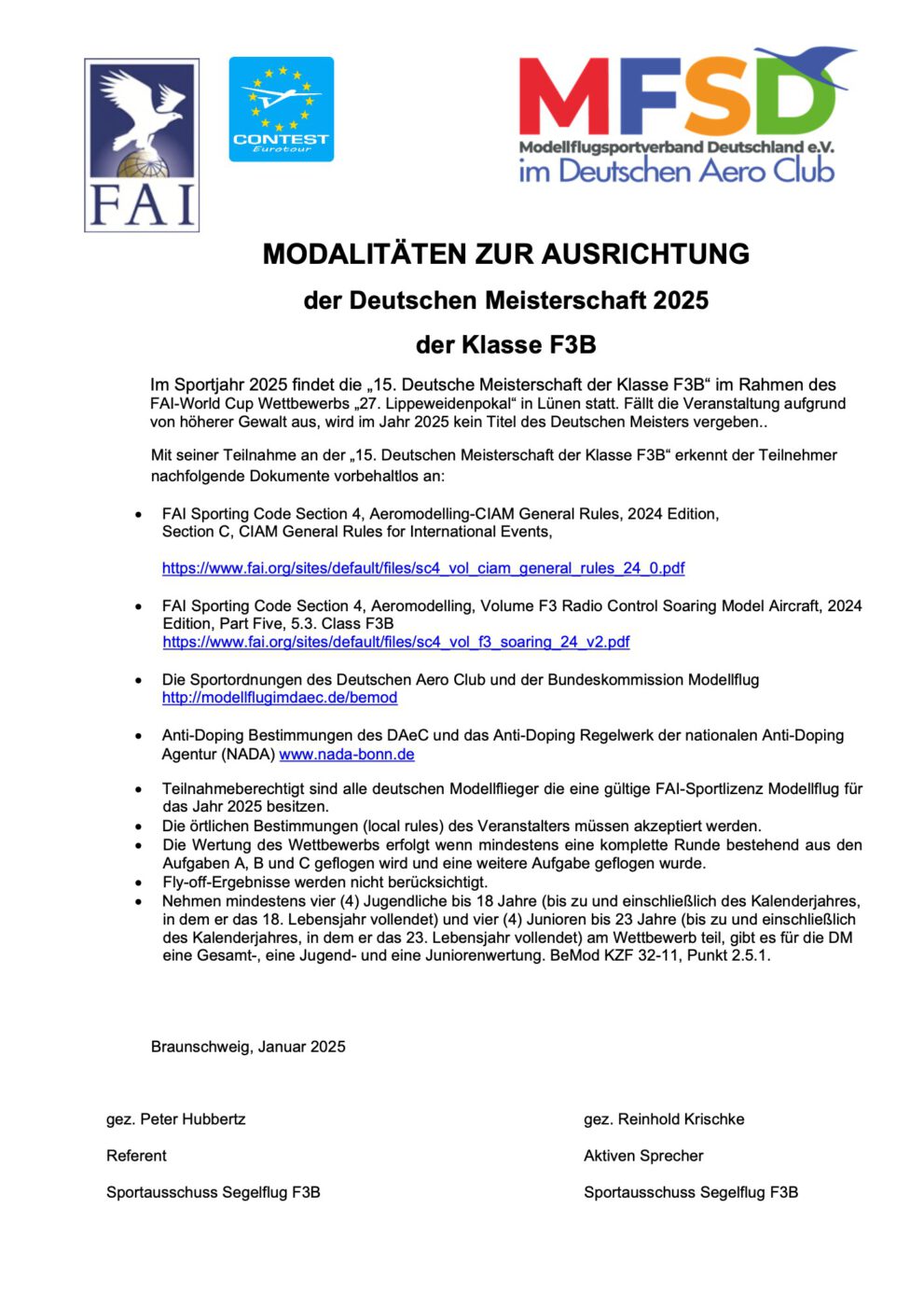
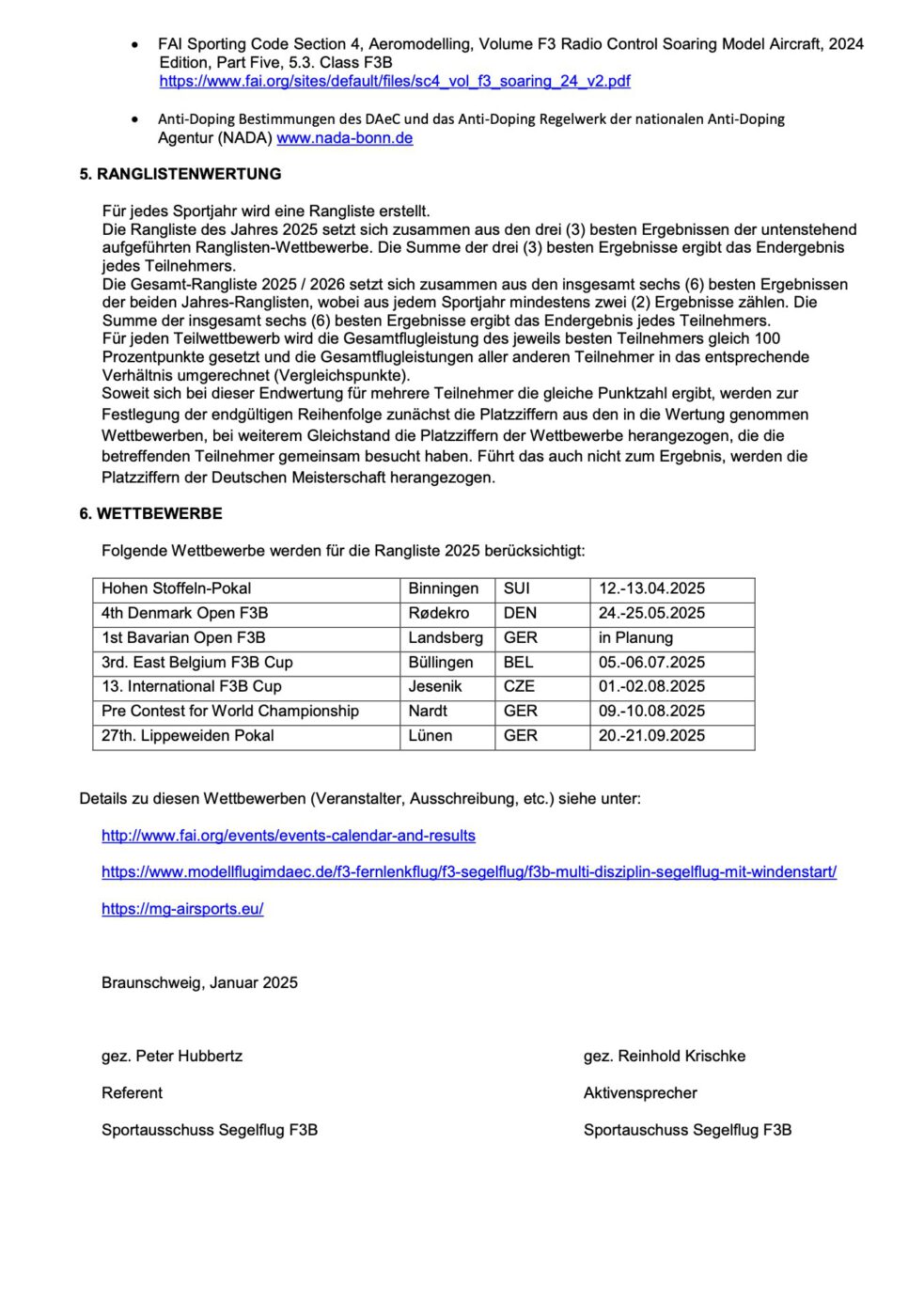
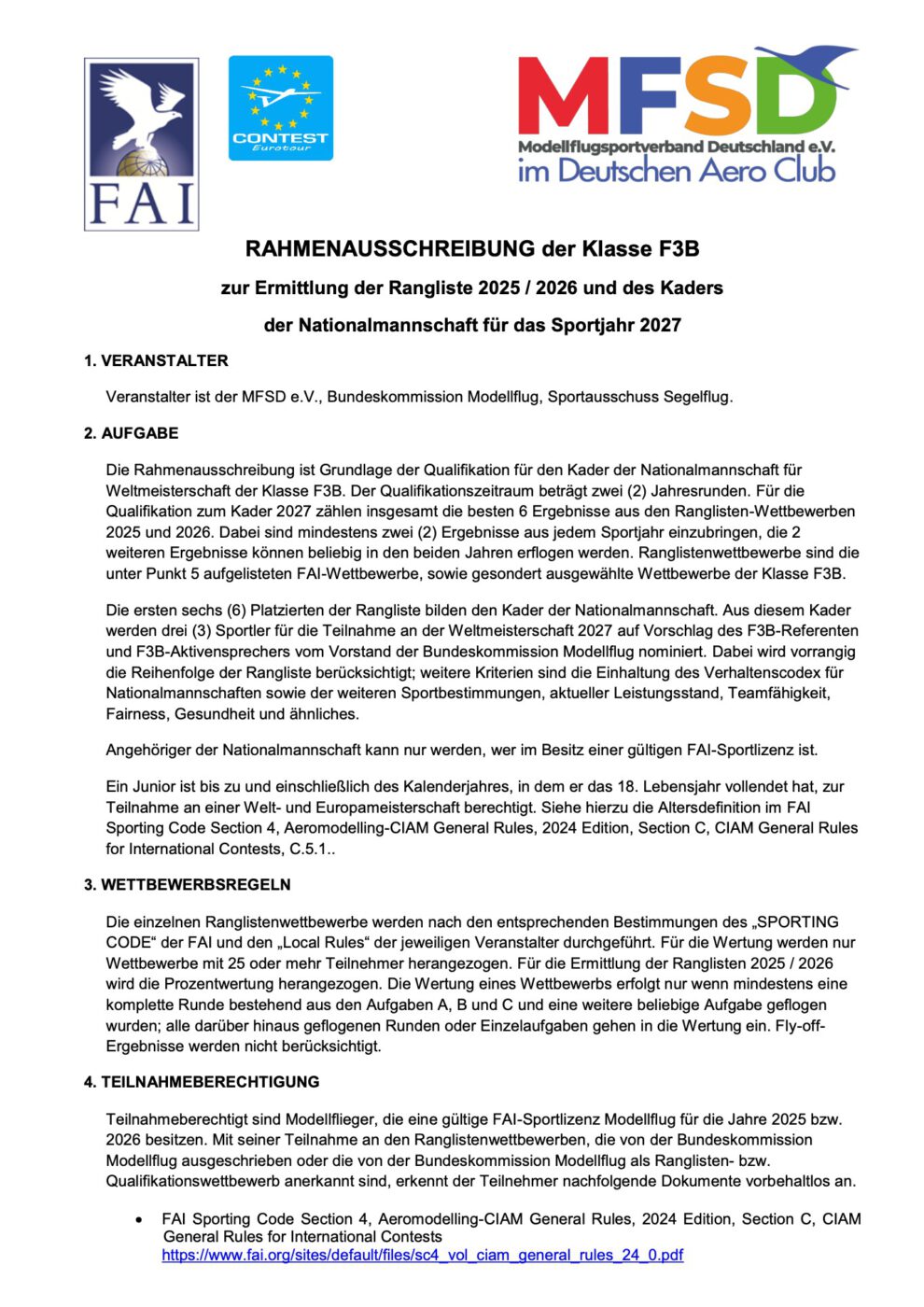
In den letzen Tagen wurde die Rahmenausschreibung zur Ermittlung der Nationalmannschaft für 2027 und die Modalitäten zur Deutschen Meisterschaft 2025 veröffentlicht.

Reports and Pictures of the World Championships 2025

Last updated: 27.8.2025

To make it easier for everyone to find everything i will collect a few links and reports here:

Results (official): https://f3b.de/2025/08/18/fai-worlds-f3b-2025/
Results (f3xvault): https://f3xvault.com/?action=event&function=event_view&event_id=3951
Results Pre-Competition: https://f3xvault.com/?action=event&function=event_view&event_id=3997

Team Australia: https://f3b.de/2025/08/26/launching-high-in-germany-the-2025-fai-f3b-world-championships/

Team Germany: https://www.f3b-team-germany.de/report-of-the-world-championships-f3b-2025/
Also see our small live feed for each day on this blog. I will add more pictures soon.

Some Videos and Pictures from Martin Weberschock: https://www.facebook.com/martin.weberschock.3
Some pictures in RC-network: https://www.rc-network.de/threads/f3b-weltmeisterschaft-2025-in-nardt-10-15-august-2025.12076925/

MDR Television: https://www.mdr.de/nachrichten/sachsen/bautzen/bautzen-hoyerswerda-kamenz/weltmeisterschaft-modellfliegen-segelflugzeug-nardt-100.html

Local television on the pricegiving: https://www.youtube.com/watch?v=ooZAD5k7Uqw

Report from a visitor on youtube: https://www.youtube.com/watch?v=-aO9tcrGA2s

Pre-Report on RC-network: https://www.rc-network.de/threads/f3b-weltmeisterschaft-2025-in-nardt-er%C3%B6ffnet-%E2%80%93-hochspannung-in-der-lausitz.12074816/

Rookie Meeting F3B MCM München 31.5.2025

The Rookie Meeting will take place on Saturday 31.5.2025.
The weather is looking great and there will be winches and support from experienced pilots. Just come by and make your first flights in F3B. Maybe you will be as enthusisatic about this sport as we are?

More Info here:

https://f3b.de/2025/04/30/f3b-und-f3g-rookie-treffen-in-muenchen/

15:00

it is getting really warm. and we have very thermal weather. two rookies are here and get to fly speed and distance. everybody is making some flights, so we also have a nice training day.

12:20

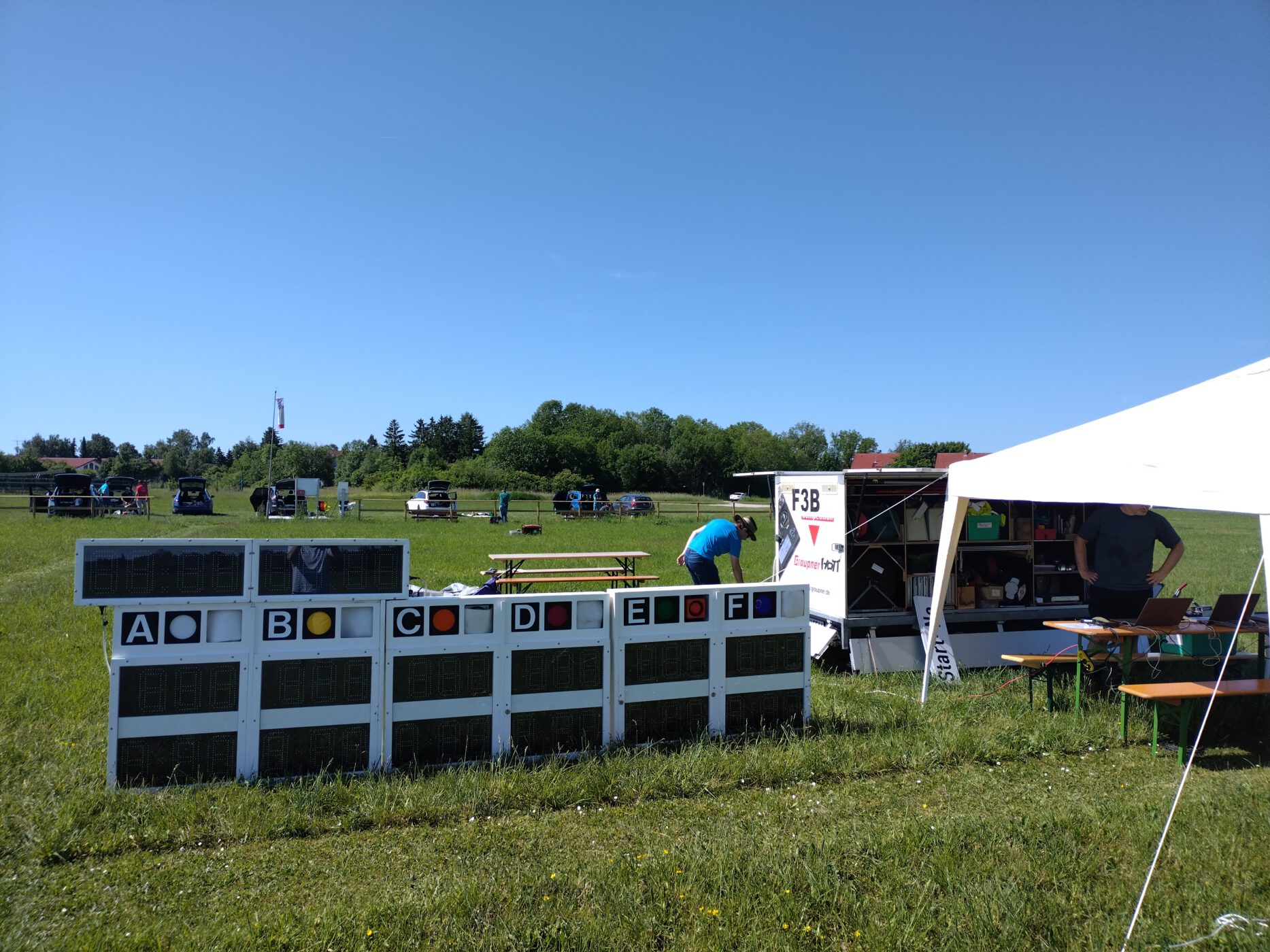
we are also testing the signaling device for the WC 2025 in Nardt

10:25

welcome back to Munich.

MCM already started the preparations. i will now build up the winches as well. lets have a great day together.

Neujahrsempfang / New Year’s reception 12.1.2024

*Deutsch unterhalb*
Exciting competitions with high tech model gliders, that is the core of F3B.
You want to know more? How can you participate?
Join us for the New Year’s reception 2025 on 12. January 2025 13:00 UTC on Youtube.

Steffen Hoppe and Christian Rieger will host this short livestream on Youtube to give you a starting point for your journey into F3B!
If you already have questions regarding F3B, you can send a personal message to the f3b.de facebook page, via email to tm.f3b@contest-modellsport.de or in the Youtube livestream. We try to answer them during the stream.

And there is a raffle by Contest Eurotour F3B with prices to give away to all pilots that already participated in 2024.

Join live:
https://youtube.com/live/WSpZnp6IXY4?feature=share
12.01.2025 13:00 UTC
Berlin 2pm
New York 8am
Los Angeles 5am
Sydney 12am
Tokyo 10pm
Ankara 4pm
_____________
Spannende Wettbewerbe mit Hightech-Segelflugmodellen, das ist der Kern von F3B.

Du willst mehr wissen? Wie kannst du teilnehmen?

Komm zum Neujahrsempfang 2025 am 12. Januar 2025 um 13:00 UTC auf Youtube.

Steffen Hoppe und Christian Rieger moderieren diesen kurzen Livestream auf Youtube, um dir einen Startpunkt für deine „Entdeckungsreise F3B“ zu geben! Wenn du bereits Fragen zu F3B hast, kannst du eine persönliche Nachricht auf der Facebook-Seite von f3b.de, per E-Mail an tm.f3b@contest-modellsport.de oder im Youtube-Livestream senden. Wir versuchen, möglichst viele während des Streams zu beantworten.

Außerdem gibt es eine Verlosung von Contest Eurotour mit Preisen, die an alle Piloten verlost werden, die 2024 bereits bei F3B teilgenommen haben.

Teilnehmen:
https://youtube.com/live/WSpZnp6IXY4?feature=share
12.01.2025 13:00 UTC
Berlin 2pm
New York 8am
Los Angeles 5am
Sydney 12am
Tokyo 10pm
Ankara 4pm